The Pearl Harbor attack of 1941 is one of the most widely known and recognized events that led to the United States' joining World War II. You can help students understand the timeline of events leading up to how our country joined the war using premade Pearl Harbor Day activities from Formative:
Teach students about the events that led to World War II and the attack on Pearl Harbor. You can use our pre-made activities to check their understanding of the topics. Want to switch up the questions? You can customize the activity templates by adjusting settings like awarding partial credit for specific questions, randomizing the question order, and tagging questions to additional standards.
Plus, Newsela Social Studies subscribers have access to even more great features that make teaching and sharing primary source texts easier than ever. Help students break down these documents at the appropriate reading levels for your specific learning objective.

In the fall of 1897, two groups, the Hui Aloha ‘Aina and Hui Kulai’aina, organized a mass petition drive to try to stop the United States from annexing Hawaii. The petitions were unsuccessful, and the Islands remained a U.S. territory from 1898 until 1959, when Hawaii became the 50th and last U.S. state.
.jpg)
In 1887, a group of foreigners known as the Hawaiian League overthrew King Kalakaua, who ruled over the kingdom of Hawaii. His sister, Liliuokalani, succeeded him. Although the Hawaiian monarchy ended with her in 1893, she and other Indigenous Hawaiians opposed the U.S. government's annexation of the Islands.
In June 1897, she wrote a letter to President McKinley protesting the annexation and hoping to change his mind about the decision. Her letter was unsuccessful, and Hawaii became a part of the U.S. territories in 1887.

In 1939, just before the start of World War II, physicists Albert Einstein, Enrico Fermi, and Leo Szilard wrote a letter to President Franklin D. Roosevelt to persuade the U.S. to develop an atomic bomb before Hitler and Nazi Germany could do so.
This letter led Roosevelt to organize the Manhattan Project, which mobilized tens of thousands of scientists and engineers and spent billions of dollars to create the first nuclear weapons. This initiative would have significant impacts across the world for decades to come.
In the early morning hours of Pacific Standard Time on December 7, 1941, the Imperial Japanese Navy launched a surprise military attack on the U.S. naval base at Pearl Harbor in Honolulu, Hawaii.
The attack sank several battleships and resulted in significant loss of life. Students can use primary source activities to understand the immediate government and civilian reactions to the events.
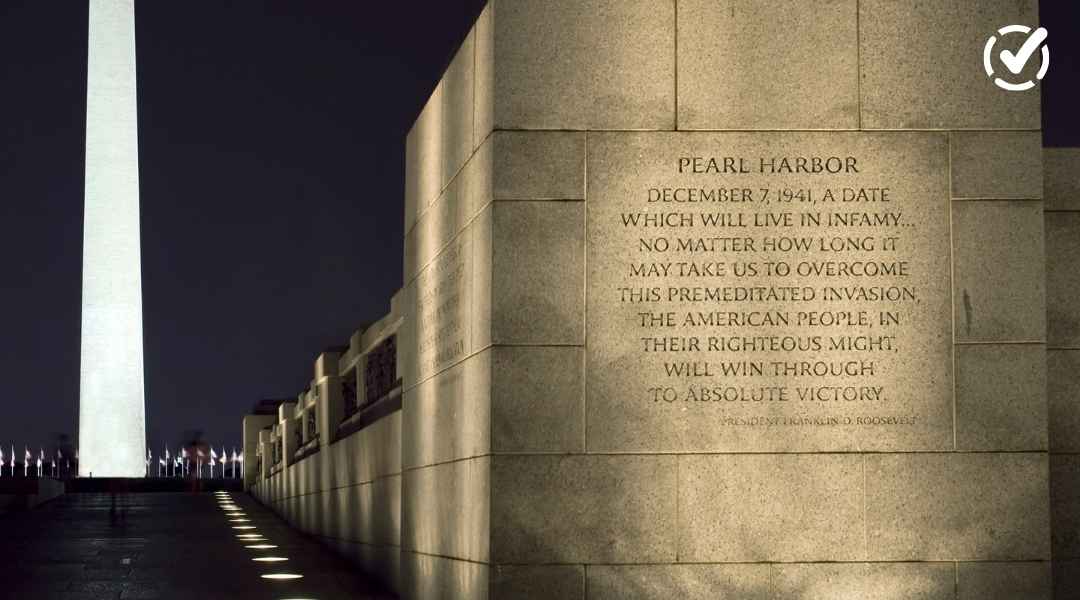
On December 8, 1941, the day after the attack on Pearl Harbor, President Roosevelt addressed Congress and the nation about what happened in the Pacific. During this speech, he delivered the often-quoted line, “A date which will live in infamy,” and announced that the U.S. would enter World War II.

Following the attack on Pearl Harbor, Americans across the nation had thoughts and opinions about the events and the country's entering World War II. Reporters in New York City, Austin, and beyond took to the streets to interview everyday citizens to record their points of view.
After the United States entered World War II, life in the country changed—and so did attitudes toward specific groups of citizens. Students can discover what happened in the aftermath of Pearl Harbor with these primary source activities:
In 1941, shortly after the Japanese attacked Pearl Harbor, President Roosevelt signed Executive Order 9066, which authorized the internment of hundreds of thousands of Japanese Americans. Even those with as little as 1/16th Japanese ancestry were subject to exclusion.
American Army General J.L. DeWitt was one of the biggest proponents of internment. He issued the first orders to move Japanese Americans to internment camps in 1942.

Conditions at Japanese internment camps were overcrowded, and there often weren’t enough cots, food, or supplies to meet everyone’s needs. Two years after internment began, Secretary of the Interior Harold Ickes sent a letter to President Roosevelt, questioning the use of the internment camps.
On August 6, 1945, President Harry S. Truman ordered the U.S. military to drop an atomic bomb on the Japanese city of Hiroshima. The explosion leveled about 90 percent of the city and killed tens of thousands of people during and after the drop.
Hours after the event occurred, Truman addressed the nation about the developments overseas, ultimately leading to Japan’s surrender and the end of World War II.
The Formative Library has a variety of free, pre-made activities developed by our curriculum experts and educators like you. You can use these templates as-is or customize them to fit your instructional needs. Use the library’s sort filters to browse content by subject and grade level to find what you want.
Create your own if you don’t see a template that matches your instructional needs! Log in to your Formative account and choose how to customize your lesson or assessment. You can create new slides with various multimedia, including audio and video, import content from Google, or enhance a PDF or existing document.
Don’t have a Formative account yet? Sign up for Formative for free today to start creating activities for Pearl Harbor Day and beyond!