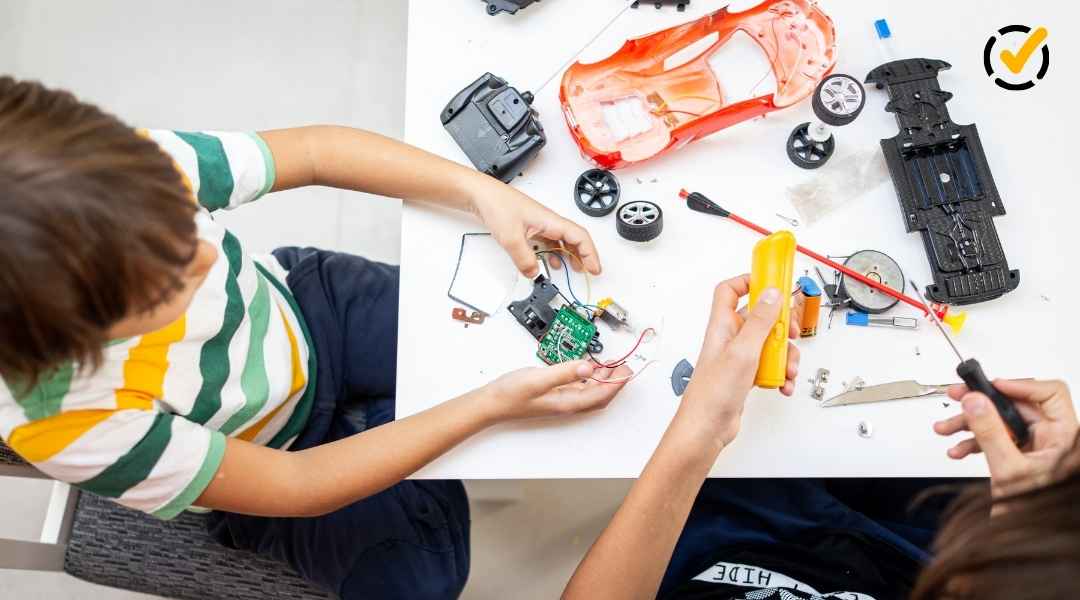
National Robotics Week is the perfect excuse to let students build, test, and rethink their ideas. You don’t need a full robotics lab to make it meaningful.
Here are classroom-ready robotics activities you can use right away, along with ways to check understanding in real time with Formative.
Jump to:
Key takeaways:
You don’t need a robotics team or a closet full of parts to tap into National Robotics Week in your classroom. What you need is structure. When students know the goal, the limits, and how they’ll reflect, the learning gets sharper—and easier.
Start with a clear task. Give students a specific goal like moving an object, navigating a path, or solving a real problem. Keep the constraints simple so the focus stays on thinking.
Formative’s Robot Design Challenge guides students step by step through the process of designing, building, and programming a robot to complete a task. Each phase includes reflection questions that help students explain what they tried and why.
You can customize this task to work specifically with any in-class robots you already use, like Dash and Dot, Spheros, Ozobots, Finches, or anything in between.
Key takeaways:
National Robotics Week activities can be fun, but if students don’t understand the processes behind the build, the learning stays at a surface level.
When you ground robotics in the engineering design process and the scientific method, students will know why they’re testing and how to revise. Plus, you have clear frameworks to assess thinking, not just outcomes.
Formative makes that foundation visible. You can check understanding before students ever touch a robot. That saves time and prevents confusion later.
The engineering design process gives students a repeatable way to solve problems. When they focus on steps like asking, planning, testing, and improving, their robotics tasks become structured rather than random trial-and-error.
Formative’s Engineering Design Process starter lesson helps you introduce the steps clearly. Students explore when and why we use the process, and you can check responses in real time to clear up misunderstandings before they stick.
Robotics is hands-on, but still runs on data and evidence. If students can’t explain the steps of the scientific method when working, they’ll struggle to explain their results, too.
Our Scientific Method science explainer activity breaks the process into six clear steps. Students can review how to state a problem, formulate a hypothesis, test it, and report the results.
Plus, inside Formative, you can see who understands the method and who needs support. That makes your National Robotics Week activities stronger and better aligned with your science standards.
Key takeaways:
At some point during National Robotics Week, you’ll need more than a cool demo. You’ll also need proof of learning. A performance task helps you capture that.
Students create something like a prototype, presentation, or written explanation, and you’ll need to see what they understand and how they apply it. Using a template inside Formative makes this easier. You’re not building from scratch, but adapting a structure that already works.
Start by deciding what students must show. Is it their design thinking? Data analysis? Ability to explain revisions? Then, plug it into an existing template.
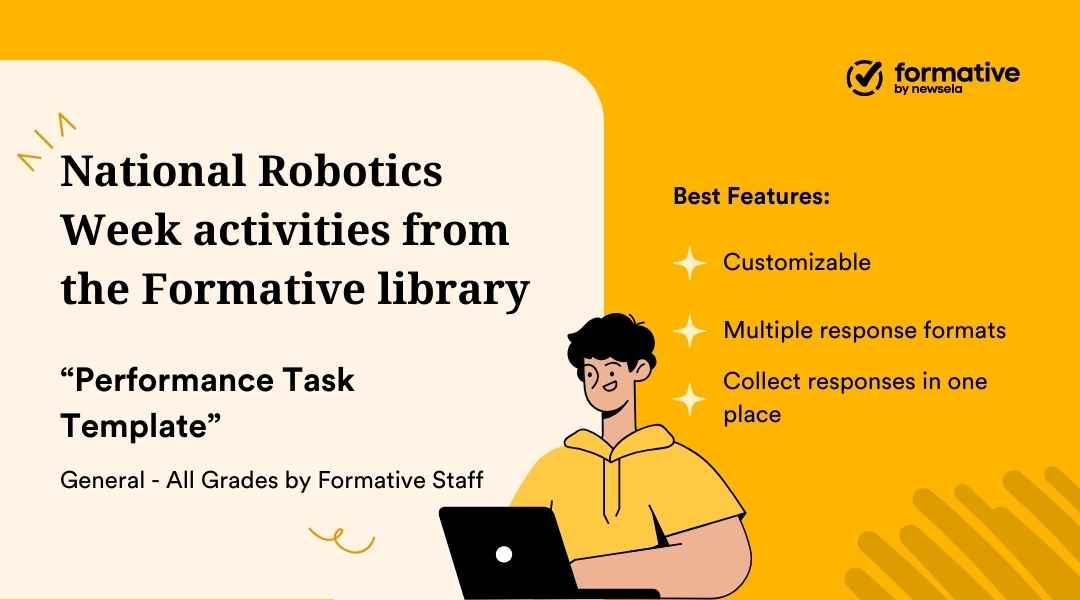
Formative’s Performance Task Template gives you a ready-made structure. Students submit responses, diagrams, images, or recorded explanations. You collect everything in one place. Customize the shell to fit your specific project needs, and add a rubric for more clarity and easier grading.
Covering National Robotics Week in your classroom can feel big, exciting, and a little chaotic. But it doesn’t have to feel overwhelming.
With structured challenges, clear process lessons, and performance tasks, you can keep the focus on thinking rather than just building.
Formative helps you plan faster, monitor understanding in real time, and collect meaningful evidence of learning. You stay in control, and students stay engaged.
When planning for National Robotics Week, use the Formative Library filters to browse by subject, grade level, and instructional focus, or build your own activities using Luna AI, multimedia, PDFs, Google imports, and interactive response types.
Don’t have a Formative account yet? Sign up for Formative for free today to start creating robotics activities that actually work in your classroom.