Asian American Pacific Islander (AAPI) Month is coming up, and like every May, time is tight. You’re probably not planning on a whole new unit to weave in concepts, and you shouldn’t have to.
We’ve got a collection of Asian Pacific Islander Month activities that you can plug into what you’re already teaching. They cover AAPI history, voices, and perspectives without taking up your prep time.
Jump to:
Key takeaways:
You don’t need to stop what you’re teaching to make room for Asian Pacific Islander Month activities. The easiest option is to tie them to a text you already use or one that fits your curriculum.
These novel studies provide a clear structure to help students look more deeply at identity, culture, and global perspectives without requiring a brand-new unit or extra prep work.

This text by Linda Sue Park makes it easy for students to think about survival, access, and perspective. You can lead students to strong discussions without forcing them. Plus, if this text is already part of your curriculum, the activities slot right in.
With a full set of tasks tied to the novel, you can move from comprehension to deeper thinking through topics like:
You can assign these activities as-is or adjust them quickly in Formative to go deeper, reteach concepts, or tailor discussions for your grade level.
Formative Fact: Try the Newsela ELA Novel Study for this book. Start your free trial today.

This text gives you the opportunity to introduce students to topics of education, voice, and advocacy. With these Formative activities, you get a structured path from background knowledge to reflection, all tied to the text. Follow this lesson sequence:
You can use the full sequence of activities or pull the ones that fit your lesson needs, depending on how much time you have to teach this book.
Formative Fact: Try the Newsela ELA Book Study for this story. Start your free trial today.
Key takeaways:
Practice activities are a great way to produce a quick learning moment that’s still targeted and relevant. Formative’s practice sets give students a way to build familiarity with important AAPI figures and ideas without interrupting pacing. You can use them as a warm-up, review, or even a short independent activity.
Give students something they can work through on their own that holds their attention. Practice sets can build familiarity without interrupting the flow of your lesson.
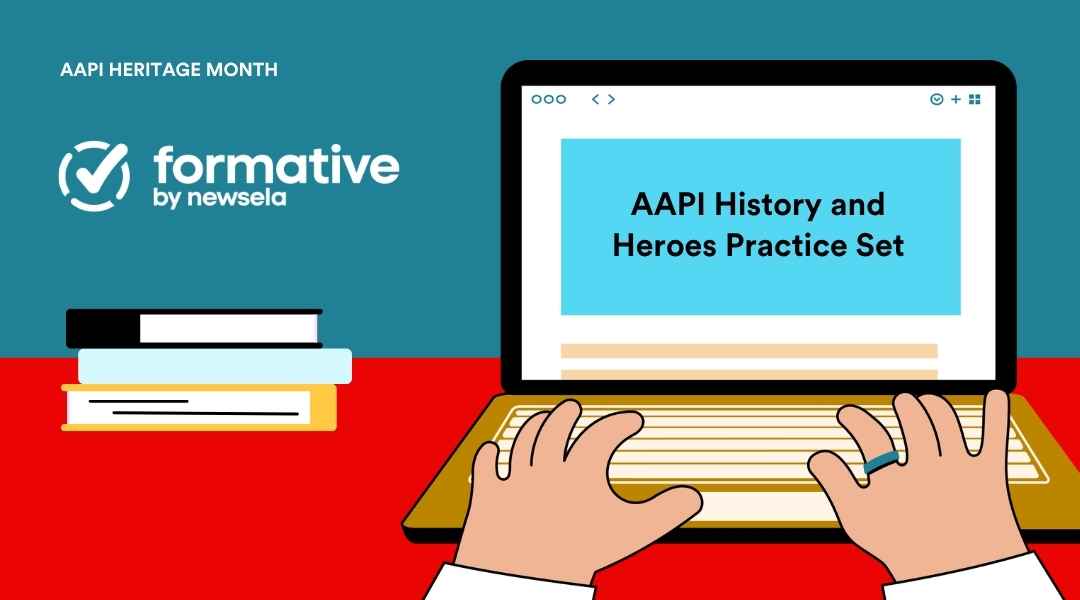
Our “AAPI History and Heroes” practice set lets students review AAPI figures from across disciplines, such as entertainment, politics, and STEM. They can use four different practice modes—flashcards, matching, quiz, or writing—depending on what works best for their learning.
Formative Fact: Learn how to make your own practice sets by watching a video.
Key takeaways:
For social studies, U.S. history, and world history teachers, incorporating Asian Pacific Islander Month activities into your lesson plans just makes sense.
These documents give students direct access to the voices behind key moments in AAPI history. When you use Newsela Social Studies in Formative, you unlock additional benefits from each document. Students can read the text at different levels and answer questions in one place.

Not everyone supported Hawaii becoming a U.S. territory and then the 50th state. Reviewing this petition adds perspective to a topic that may usually be covered from just one side.
Our Formative activity pairs the text of the 1897 Petition with questions that guide students through close reading and analysis. They can work through the text and respond in one place while you monitor results in real time to adjust instruction.

World War II and Japanese internment are often big topics in high school U.S. history courses. Reviewing the actual relocation orders from General J.L. DeWitt gives students a direct look at how internment happened and the language and decisions behind it.
The Formative activity uses the original order to guide students through analysis and discussion. They can read, annotate, and respond in one place to better guide their understanding.

Forty years after the end of World War II and the end of Japanese-American internment, Congress passed the Civil Liberties Act of 1988. The bill provided compensation for survivors of the internment camps for American citizens and permanent residents of the United States.
With this Formative activity, students can see what happened after the internment ended and provide analysis and reflection on the text's actual words rather than a summary.
Key takeaways:
Letters and speeches from history allow students to hear directly from the people involved. Instead of just learning what happened, they look at how people responded, argued, and pushed for change.
When you use Newsela Social Studies in Formative, you unlock additional benefits from each letter or speech. Students can read the text at different levels and answer questions in one place.

When the U.S. wanted to annex Hawaii, the Native Hawaiian leadership didn’t support the decision. Exploring Queen Liliuokalani’s letter to President McKinley helps students question the idea of inevitable expansion using her words.
With the Formative activity, students can read the Queen’s letter and analyze her argument, tone, and purpose. This activity works well for a short written response or discussion, especially if you want to back up claims with evidence from a real source.
.jpg)
Following the Spanish-American War, Spain gave its longstanding colony of the Philippines to the United States. Just two days before the annexation treaty was supposed to go into action, Filipino nationalists and American forces clashed in what became known as the Philippine-American War.
The year before the war began, Felipe Agoncillo published a letter in “The New York Times, pleading with the U.S. government to give the country independence instead of colonization.
This Formative activity centers on Agoncillo’s letter, so students can examine how he made his case and whom he was trying to persuade. It’s a good fit for quick discussion or a short written response.

Not everyone in the U.S. government supported Japanese American internment during World War II. Students can see that people like Secretary of the Interior Harold Ickes raised concerns about conditions in the camps.
This Formative activity covers Ickes’ letter so students can examine how he questioned the treatment of Japanese Americans and how he framed those concerns to President Roosevelt. It’s a good activity to help students analyze point of view and weigh competing perspectives.

In 2020, Kamala Harris became the first woman, Black woman, and woman of Indian heritage to be elected vice president. Her speech highlighted the need to fight for justice and equality and recognized the historic moment for women—especially those of Black and Asian backgrounds.
This Formative activity covers her acceptance speech so students can look closely at how she spoke to the audience, marked this significance of the moment, and built a broader message about justice and opportunity.
It works well as a rhetorical analysis activity. You can also use this content to help students compare how historical and modern speakers respond to power, change, and public responsibility.
The right AAPI Month activities make it easy to plug meaningful content into what you already teach.
The Formative Library gives you ready-made activities you can use right away or adjust quickly. You can assign them as-is, tweak questions, or build your own with existing materials or help from Luna AI.
Don’t have a Formative account yet? Sign up for Formative for free today to start creating activities for AAPI Heritage Month and beyond!