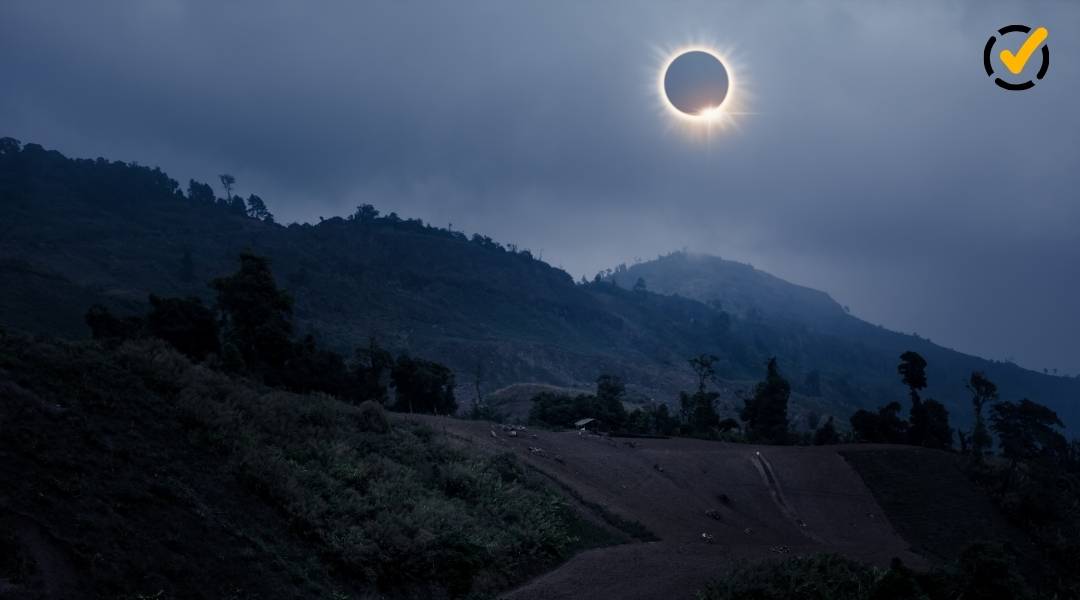
The 2026 eclipse events are rare moments when student curiosity is already piqued. You don’t have to convince them that learning matters when they’re already asking questions about what’s happening in the sky.
With ready-to-use activities across science, math, ELA, and social studies, Formative helps you turn the 2026 eclipses into meaningful instruction, while collecting real-time data that lets you adjust teaching on the fly.
Jump to:
Key takeaways:
The 2026 eclipses are a perfect intro moment for science concepts like light, shadows, moon phases, and the structure of the solar system. Because students are already curious, you can focus less on getting them to care and more on guiding their understanding.
With Formative, you can launch eclipse science lessons instantly and see student thinking as it develops, so you know when to slow down, clarify, or push learning further.
Shadows and light patterns are often the first eclipse-related ideas students notice. Before they can understand how an eclipse works, they have to explore how light behaves when objects block it.
You can use our “Sun and Shadows” science starter lesson to build this foundation. It’s perfect for early elementary students to practice and consider new concepts. As students respond, Formative shows you who understands how shadows form and who may need additional modeling.
Moon phases are key to understanding why eclipses occur when they do. Exploring lunar cycles helps students connect patterns over time to eclipse events.
Use the “Moon Phases” science starter lesson to check comprehension of the topic before students apply the concept to eclipse timing. This ready-made lesson is perfect for middle school, but can be adapted for other grade levels.
To better understand eclipses, students need a context of how the solar system is structured and how celestial objects interact. The “Exploring Our Solar System” science activity helps them learn about planets, moons, stars, and other bodies in our solar system.
Earth’s position matters for the types and timing of the eclipses we see. Understanding planets helps students see eclipses as part of a larger system. Use the “Planets in Our Solar System” science explainer activity to explore Earth and its celestial neighbors.
Key takeaways:
Like with science, eclipses also lend themselves to math instruction. Concepts like position, movement, and spatial reasoning all matter when viewing an eclipse. These ideas become easier to understand when students can connect them to a concrete event.
Formative lets you integrate math seamlessly while tracking student thinking in real time.
What we see during an eclipse depends entirely on the position of the Earth and the moon, and their relationship to the sun. This makes position an ideal math connection around an anticipated eclipse.
Use the “Object’s Position” math starter lesson—perfect for your youngest students—to teach these concepts. As students work, Formative shows you exactly how they’re reasoning out objects’ positions and where they may need help.
Key takeaways:
The 2026 eclipse isn’t just a science lesson. It can also be a powerful opportunity for students to write, reflect, and make meaning through language. With Formative, you can collect student writing and give feedback while their ideas are still forming.
Writing helps students process what they observe and learn. Whether students imagine witnessing an eclipse, talk about a previous experience seeing one, or reflect after one in 2026, narrative writing can help deepen their understanding.
Formative’s “Personal Narrative” ELA starter lesson is perfect for helping upper elementary students reflect on firsthand experiences. As students write, you can respond in real time and support them before misconceptions take hold.
Key takeaways:
Eclipses are part of a much larger story about humanity’s interest in space. Social studies lessons help students understand why space exploration matters and how history shaped what we know today.

The Space Race transformed how nations approached science and technology. Understanding this history helps students connect past exploration to present-day eclipse science. Students can’t read and explore President John F. Kennedy’s “We Choose to Go to the Moon” speech to better understand the context of the Space Race.
This resource supports close reading, discussion, and reflection while capturing students' responses in real time.
Engage students across science, math, ELA, and social studies with ready-to-use digital activities that save prep time and boost participation. Formative makes it simple to track learning, give feedback, and turn seasonal lessons into meaningful instruction.
Not a Formative customer yet? Sign up for free to access these activities and more to bring the 2026 eclipses—and other seasonal activities—to life!