How often do you open a spreadsheet and realize that the student data inside is already outdated? Interim and summative assessment results arrive too late. By the time you see the scores, the learning window has closed, and misconceptions are firmly in place. Then, even worse, all that data sits untouched in your spreadsheets, basically useless.
Formative assessment data changes that. It gives you and your teachers real-time insight into what students understand right now. When your collection and analysis systems are tight, that data drives instruction, strengthens professional learning communities (PLCs), and improves performance before high-stakes tests ever hit.
Jump to:
Key takeaways:
When you look at formative assessment data the right way, you’re not just looking at student scores. You’re looking at instructional impact.
Formative assessment works because it happens during instruction, not after. That means the data is actionable instead of historical. With your leadership, it can be a great driver for student achievement.
When teachers collect formative assessment data during lessons, they see misconceptions while they’re forming, not weeks (or months) later.
A meta-analysis on reading achievement found that formative assessment significantly improves K-12 outcomes when teachers use the evidence to adjust instruction.
The keyword is use.
Formative assessments aren’t just a way to “get a grade in the book.” The data has to inform instructional change. For example, if you see that 70% of students are missing the same standard in a quick check, that’s an instructional signal that more work, or different work, needs to be done.
As a educator, this can help you ask better coaching questions, like:
The data shifts the conversation from “why didn’t they get it?” to “what can we do tomorrow to get back on track?”
More data doesn’t always equal better decisions.
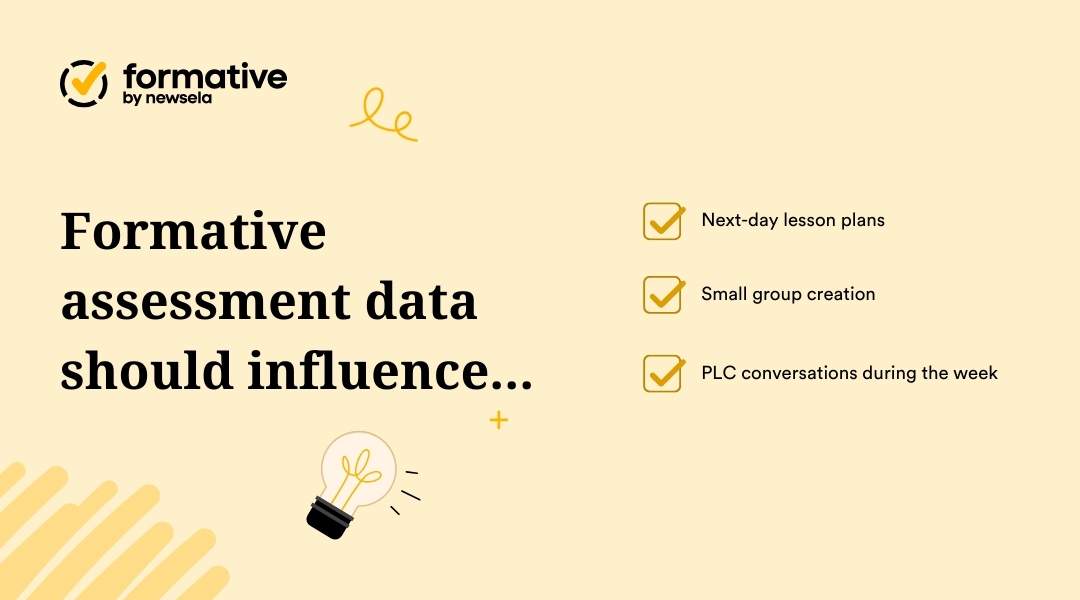
Research consistently shows that formative assessment works because it’s timely and embedded in instruction, not because it’s large-scale. If the data sits untouched, it expires. That’s why formative assessment data should influence:
When admins are looking at formative data, you’re not looking for individual grades. Instead, you want to analyze trends. Look for:

The CEELO policy report notes that formative assessment supports continuous improvement cycles when you monitor patterns over time. This is where a centralized system can help.
If your formative assessment data lives in ten different places, you can’t see schoolwide signals. Platforms like Balanced Assessment by Formative allow you to aggregate results across teachers and standards. Doing this can boost clarity and make spotting patterns easier.
Key takeaways:
When you use formative assessment data well, outcomes improve—and you can measure them. The impact doesn’t come from giving more quizzes, but from acting on the evidence those checks provide.
That distinction matters.
According to a K-12 reading achievement study by Xuan, Cheung, and Sun, formative assessment significantly improves student performance when teachers use the results to adjust instruction.
The gains were strongest when feedback was specific and instructional changes followed quickly.
This aligns with decades of additional research that shows formative assessment produces some of the largest effect sizes among classroom interventions.
As a leader, that means instructional response is the lever you should pull and enforce, not just giving the assessment itself.
When formative assessment data is part of feedback instead of grading, students start to see mistakes as part of learning, not permanent failure.
Research comparing formative and summative assessments found that formative approaches significantly reduced test anxiety and improved academic motivation and self-regulation skills.
And it’s not just about boosting grades. Lower anxiety changes student behavior. They’ll attempt harder tasks, revise their work, and engage more fully.
But why does this happen? It’s because using formative assessment data as feedback shifts the focus from performance to progress.
According to Nicol and Macfarlane-Dick’s model on formative assessment and self-regulated learning, effective feedback helps students understand where they are, where they’re going, and how to close the gap.
As a leader, this matters because motivation affects attendance, persistence, and classroom culture. If your teachers are using formative assessment data as forward-looking feedback rather than score collection, you’re not just improving academics. You’re positively influencing your students’ mindset.
Surprisingly, it’s not you or your teachers that benefit most from using formative assessment data. It’s actually your students who have fallen furthest behind.
Research consistently shows that formative assessment has the strongest impact on struggling students because it provides immediate, targeted feedback instead of delayed judgment.
When teachers use real-time evidence to reteach, adjust grouping, or clarify misconceptions, students don’t sit confused for weeks. Teachers don’t have to wait for them to speak up or say, “I don’t get it.” They’ll know based on the data.
The Hanover Research report on formative assessment and learning intentions also notes that clear success criteria paired with ongoing feedback improve achievement, especially for students who need more structured support.
This shifts equity from reactive to proactive. Instead of waiting for summative data to reveal achievement gaps, formative assessment data lets you intervene early.
Formative assessment data only becomes good feedback if students understand what they’re aiming for first.
When learning intentions and success criteria are clear, feedback is meaningful. Without them, a formative assessment is just activity tracking.
Hanover Research found that pairing formative assessment with explicit learning intentions leads to stronger student achievement gains. That means they perform better when they understand the target.
This aligns with additional research on feedback and self-regulated learning. Effective formative feedback helps students answer three questions:
As a leader, this affects how you look at classroom practices. If teachers are collecting formative assessment data, but learning targets aren’t clear or referenced, the impact drops. But when teachers align standards, success criteria, feedback, and instructional changes, formative assessment data can become a growth tool.
Key takeaways:
Collecting formative assessment data isn’t about adding more assessments to your schedule. It’s about collecting the right evidence at the right time. If the evidence doesn’t inform a next step, it isn’t serving its purpose.
As a leader, this means you can use it to help teachers focus on alignment, clarity, and usability, not volume.
Formative assessment data only helps if it connects directly to what students are supposed to learn. If a quick check doesn’t tie to a specific standard or learning target, it’s just an activity instead of producing actionable data.
That alignment is what makes the data instructional. As an administrator, this shows up in two ways. First, your teachers should be able to name the exact standard a formative task measures. Second, your PLC conversations should revolve around standard-level performance, not overall percentages.
When teachers tag or organize formative assessments by standard, you gain visibility across classrooms. Tools like Balanced Assessment by Formative allow teachers to align items to standards and filter results accordingly.
That’s where the shift happens. You can ask questions like “which standards need reteaching across sixth grade?” and there’s data to back it up.
The most useful formative assessment data shows student thinking. Multiple-choice checks can surface patterns quickly, but short responses, explanations, and problem-solving steps reveal deeper misconceptions.
If a student selects the correct answer but can’t explain why, they may actually know the answer, or they might be guessing. You’ll never know unless you prompt them to explain.
Research on formative assessment and science education reinforces this thinking. When students share their reasoning, teachers get clearer instructional signals about their learning and can respond in the right way.
As a leader, this also shapes what you can look for when doing teacher observations. Are they:
.jpg)
Looking for these cues can help you provide more solid feedback and coaching and use your formative assessment data to the fullest.
Formative assessment works best when it’s embedded during learning, so teachers should be collecting this data constantly. That can look like:
Formative assessment has the strongest impact when feedback is timely and directly connected to the task. It should trigger same-day instructional adjustments, and if it can’t, then the data is already too late.
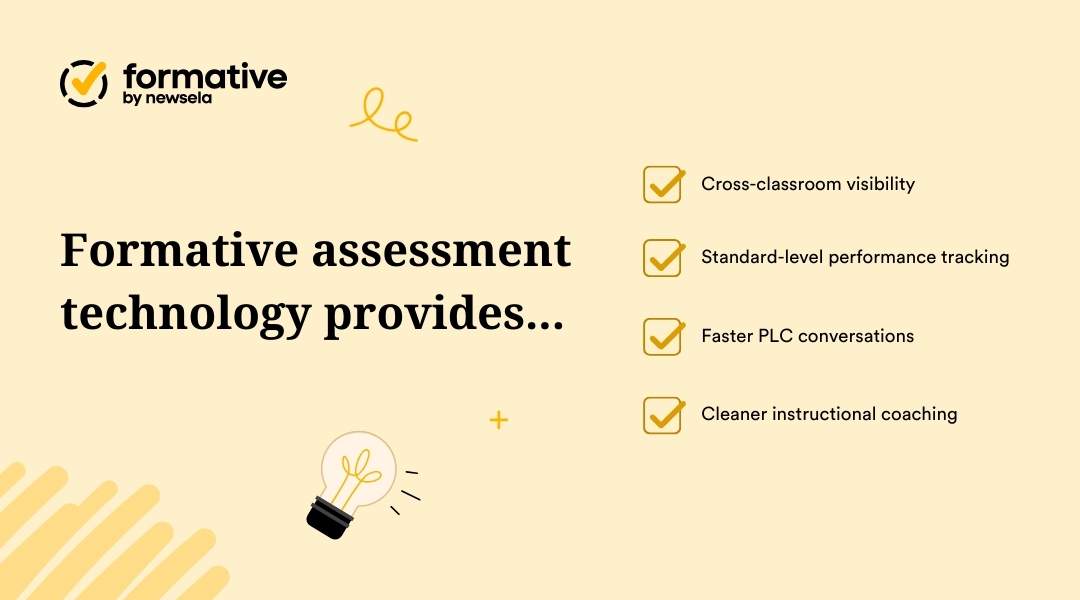
Technology doesn’t make formative assessment stronger by itself. It makes the data easier to see, organize, and act on. When formative assessments live in too many places, patterns disappear, and leaders can’t see trends across classrooms.
Centralized, digital platforms can solve that problem. When teachers can tag items to standards, filter by skill, and view results instantly, everyone gets visibility that helps move from classroom-level insights to schoolwide action.
For leaders, this means you’ll gain:
Learn more: Ask Us Anything: Configuring Balanced Assessment for Your District
Key takeaways:
Formative assessment data doesn’t scale on its own. Individual teachers can use it well, but without systems, the impact stays isolated.
Research on formative assessment implementation consistently highlights leadership support, collaboration, and shared best practices as critical for sustained improvement.
If teachers feel judged instead of supported, they’ll stop using data. If there’s no time to analyze patterns, the critical feedback window expires. As a leader, your role isn’t to just collect teachers’ formative assessment data. It’s to create the conditions where it drives instruction across teams.
If there’s no time to analyze formative assessment data, you’re never going to look at it.
That might sound obvious, but it’s true. Teachers need dedicated time together to look at, talk about, and strategize around using formative assessment data.
Don’t let your PLC meetings revolve around pacing calendars and logistics alone. Make time for discussing:
As an admin, you can plan for and protect these discussion spaces by:
When PLCs become problem-solving sessions, growth accelerates.
Key takeaways:
Collecting formative assessment data is actually the easy part. Acting on it is where your leadership skills show up.
Formative assessment works because it changes what happens next. It informs small-group activities, shapes next-day lesson plans, and guides feedback. If nothing shifts, the process stalls.
You can ensure that doesn’t happen.
When formative assessment data shows confusion, the response should be immediate. Not next week, not at the end of the unit, but right now. In-the-moment adjustments might look like:
These adjustments are the intervention. And they’re exactly what you can look for during teacher evaluations.
Formative assessment data makes grouping strategic instead of random. Teachers can group students by specific misconceptions or skill gaps. It’s more precise and more effective than just pulling together “high achievers” or “low performers.”
Research on formative assessment shows that achievement gains increase when feedback and instructional adjustments match specific learning needs. Small groups are one of the fastest ways to deliver that targeted support.
As a leader, these types of classroom experiences shift your strategy from asking “are teachers differentiating?” to “is differentiation based on current formative assessment data?” This is a different level of rigor that allows for instruction to become responsive instead of reactive.
Effective feedback doesn’t just explain what’s wrong, it shows what to do next. Feedback is most powerful when it helps students close the gap between current performance and the learning goal. That means feedback should be:
For admins, these guidelines can change your coaching conversations. Ask teachers:
Formative assessment data becomes stronger when students see and use it, too. Students can:
A study from PubMed Central also found improvements in motivation and self-regulation when formative practice happened consistently. This can influence how you look at strategies and systems. You don’t just want to know if students are on task, but if they know what they’re working toward and how close they are to getting there.
When students track formative assessment data themselves, they shift from passive learners to active learners.
Formative assessment data only works if your systems support it.
Teachers need simple ways to collect aligned evidence. PLCs need clean reports that show patterns by standard. You need visibility across classrooms without chasing down spreadsheets.
Balanced Assessment by Formative helps you centralize formative assessment data, align it to standards, and analyze results in real time. Teachers can tag items, filter by skill, and adjust instruction quickly. Leaders can monitor trends across teams and support targeted coaching.
If you’re ready to move from collecting formative assessment data to acting on it consistently, let’s talk!